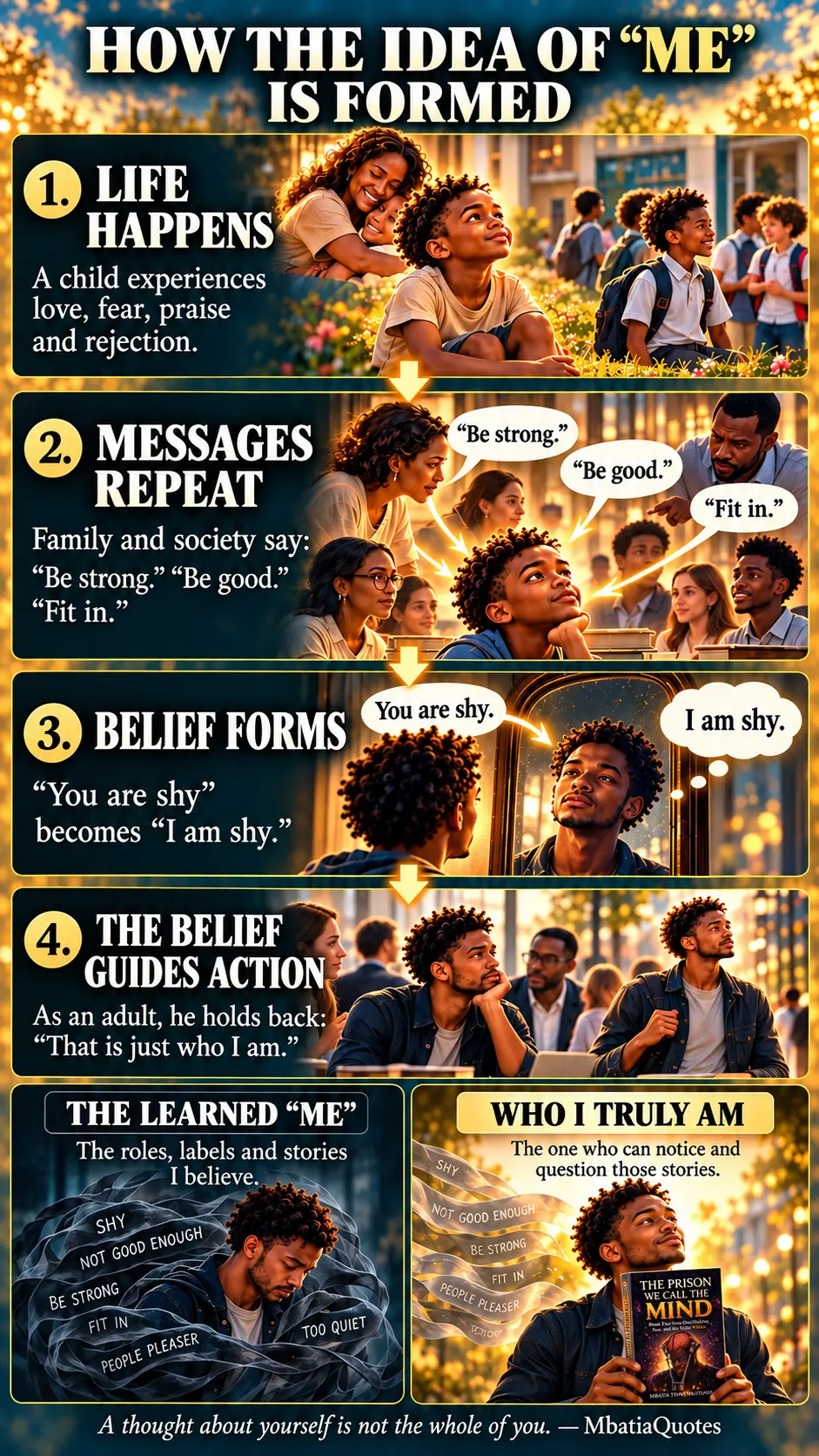
Before a child can explain who they are, life is already happening to them. They are held, praised, corrected, welcomed, ignored, frightened, and comforted. None of these moments alone defines the child. Yet each one leaves an impression, especially when it happens again and again.
Then come the words. “Be strong.” “Be good.” “Don’t make a fuss.” “You are shy.” Some messages help us live with others. Some protect us. Others quietly narrow what we believe is possible for us. A child learns them from the people they depend on, the culture around them, and the way they are treated.
Imagine a child who speaks softly in a room full of people. Someone says, “He’s shy.” The next time, another person says it too. Soon the child begins to expect himself to be shy. They say I am shy becomes I am shy. What began as a description of a moment hardens into a description of a person.
Years later, he sits in a meeting with an idea worth sharing. A thought appears: People like me don’t speak up. He stays quiet. The silence seems to prove the thought right. With every repetition, the story feels more like a fact. He goes to work, loves people, makes choices, and walks through his days calling this collection of memories, roles, and beliefs “me.” He may never notice how much of it was learned.
The story is repeated for so long that it begins to feel like the person living it.
This is how identification works. A thought arises, and instead of hearing it as a thought, we hear it as the final word on who we are. I failed once becomes I am a failure. I was rejected becomes I am unlovable. Even flattering labels can become cages when we feel we must live up to them at every moment.
Freedom begins with a small pause. The man in the meeting notices the familiar thought: I am shy. For once, he does not have to obey it or fight it. He can ask, “Is this always true? Whose voice does it sound like? What would I do right now if I did not need to defend this story?” He may speak, or he may choose to listen. What changes is that the choice is his.
The past still happened. The lessons he learned may still be useful. But the story is no longer the whole of him. There is also the capacity to notice it, question it, and respond to this moment as it is. That is the freedom I mean: no longer mistaking every thought about yourself for who you truly are.
— Mbatia Muitungu
The Prison We Call the Mind
If this resonates with you, explore the full journey in my book. It looks more deeply at how the mind’s stories take hold—and how awareness helps us meet them with greater freedom.
Explore the book on Amazon